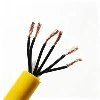
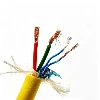
When buyers first look at a cable, they usually read off cores, cross-section and price. What actually decides whether it survives three years underwater or a million flex cycles in a drag chain is the work you never see.

Conductor. Flexible cables use stranded copper. In the same 0.5 mm², seven 0.30 mm wires and twenty-eight 0.12 mm wires behave very differently in flex life. A shorter lay length gives a softer cable; 99.99% oxygen-free copper at roughly 58 MS/m keeps voltage drop low over long runs.
Insulation. Only 0.2–1.0 mm thick, yet it must hold off thousands of volts - a matter of dielectric strength and extrusion concentricity. PVC for 70/90 °C, XLPE for 90 °C power, fluoropolymers for 200 °C, silicone staying flexible at −60 °C, PUR/TPU for abrasion and hydrolysis resistance.
Shielding. VFDs, sonar and underwater cameras are all noise sources. Braids at 85% or 95% coverage, or foil-plus-braid constructions, are best judged by transfer impedance rather than by the presence of a braid alone.
Cabling and strength members. Lay length and fillers determine whether cores rub against each other under bending - the root cause of many broken-core failures. Tethered and ROV cables carry load on aramid, while neutrally buoyant designs bring specific gravity close to 1.0.
Jacket. It faces four aging paths at once: hydrolysis, UV, oil and repeated bending. PE for continuous immersion, PUR/TPU for high-flex duty, LSZH for ships and metros, plus salt-spray resistance on deck. Same black surface, one grade apart, several times the service life.
Testing. Spark testing metre by metre, conductor resistance, withstand voltage, insulation resistance, aging and flex fatigue - plus pressure and air-tightness tests for subsea cables. UL, CE, TÜV, SAA and CCS matter less as certificates than as a promise of consistency: this batch must match the next.